
The Showcase: Intel Corp (INTC)
The only foundry that had no choice but to win
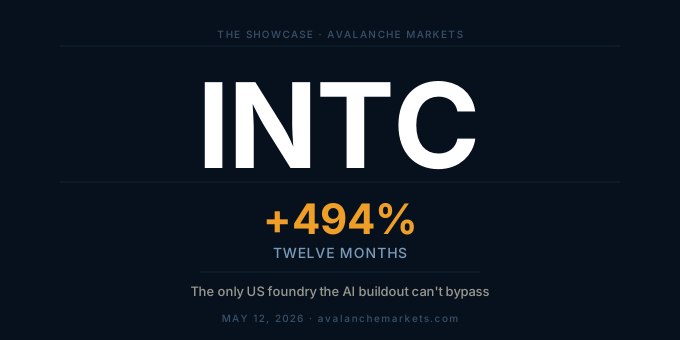
The Showcase: Intel Corp (INTC)
The Only Foundry That Had No Choice But to Win
This morning the Bureau of Labor Statistics confirmed what the bond market had been whispering for weeks: April CPI came in at 3.8% year over year, above the 3.7% forecast, accelerating hard from March's 3.3%, and fueled by oil above $100 on a US-Iran ceasefire the President described as sitting on "massive life support." The market did what markets do — it found everything that had recently made money and sold it. Intel, which had recently made a lot of people money, was down 8.5% before lunch. The stated reasons were the inflation print and a KeyBanc note showing April notebook shipments fell 27% month over month.
Both reasons are real. Neither one is the thesis.
Why the Trade Doesn't Care About the Fed
The AI infrastructure buildout is not a theme trade and it does not respond to hot CPI prints the way speculative growth stocks do. The correct mental model is a prisoner's dilemma playing out at a scale that makes prior technology cycles look modest. Nobody can afford to be the company that chose margin discipline while everyone else purchased the operating system of the next twenty years. The hyperscalers are collectively spending roughly $750 billion in capital expenditures in 2026 alone. Not because the spreadsheet said the returns look great, but because the cost of being wrong on the downside now exceeds the cost of overspending.
Rate pressure hurts companies that need cheap capital to survive. It does not stop companies spending because stopping means losing. The Federal Reserve can do whatever it wants in June. Amazon is still building data centers. And somewhere in that supply chain, a specific bottleneck keeps asserting itself: the United States has exactly one company capable of manufacturing leading-edge chips on domestic soil.
That company is Intel. And for most of the last three years, it looked like it might not make it.
The Bottom, and the Man Who Found It
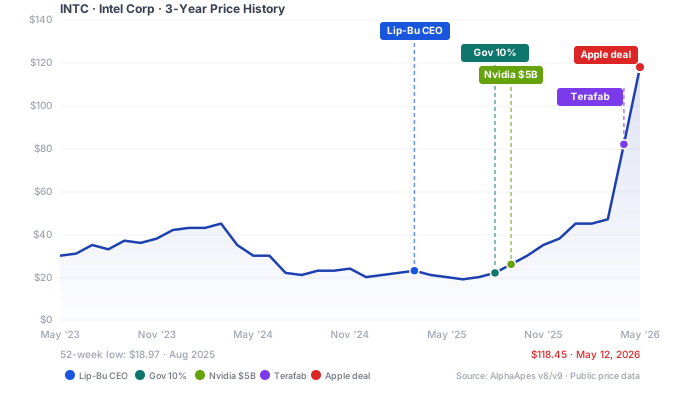
Look at that chart. In mid-2025, when the stock touched $18.96 in August, down from $54 just months earlier with analysts debating whether the company should simply be broken apart, the story was not just about manufacturing delays and competitive missteps, though it was certainly those things. It was a story about what happens when a great company loses the connection between what it builds and who actually needs it.
Pat Gelsinger had vision. He understood what Intel could become as the anchor of US domestic semiconductor manufacturing. He just could not close the gap between the vision and the results fast enough, and by December 2024 the board gave him a choice between retirement and removal. He retired.
Lip-Bu Tan walked in fourteen weeks later, and if you wanted to design the precise opposite of the previous regime, you would design something close to him.
His playbook had already worked once. At Cadence Design Systems from 2009 to 2021, he inherited a company in disarray and delivered 3,200% stock appreciation over twelve years by doing something deceptively simple: he made the company obsess over the customer instead of itself. Revenue more than doubled. Margins expanded. He operated quietly and compounded emphatically. His philosophy of underpromising and overdelivering reads almost like a provocation given the Gelsinger era's appetite for grand announcements and delayed deliveries.
At his first Intel Vision conference in spring 2025, days into the job, he told customers plainly: "My number one priority has been spending time with you. Under my leadership, Intel will be an engineering-focused company. We will listen closely and act on your input." Six consecutive quarters of beating earnings guidance later, the results have validated the promise with the kind of clarity no press release can manufacture.
One year in, Tan told Fortune: "A year ago the conversation around Intel was about whether we could survive. Today it's about how quickly we can add manufacturing capacity and scale our supply to meet enormous demand for our products."
The Deals That Confirmed It
A culture shift is a thesis. Signed agreements are evidence.
In August 2025, the US government purchased a 9.9% stake in Intel for $8.9 billion, converting previously awarded CHIPS Act grants into equity, because Washington decided it could not afford a world in which America's only leading-edge domestic chipmaker failed. In September, Nvidia invested $5 billion. Pause on that. Nvidia, which built an empire by being fabless and outsourcing all manufacturing to TSMC, wrote a nine-figure check to its only domestic foundry alternative. That is either the most sophisticated hedge in semiconductor history or a genuine signal that Nvidia knows something the bears have been slow to price.
In April 2026, Intel was named primary foundry partner for Terafab, the $20 to $25 billion compute project anchored by SpaceX, Tesla, and xAI. And four days ago, the Wall Street Journal reported that Apple and Intel had reached a preliminary agreement for Intel to manufacture Apple chips on the 18A process node, cracking TSMC's monopoly on Apple silicon for the first time since the iPhone was invented. Apple CEO Tim Cook had said on the most recent earnings call that iPhone supply was constrained because TSMC simply could not produce enough chips to meet demand. Chip analyst Ben Bajarin of Creative Strategies put it cleanly: "Intel is the only place that can scale up capacity as a viable second source."
Four of the most strategically significant entities in the world making large, irreversible bets on Intel's ability to execute. That is not coincidence. That is confirmation.
The Part the Spreadsheets Are Missing
The AI infrastructure trade started with GPUs, and Nvidia won that phase decisively. But AI is moving from training into inference. Where training teaches models, inference runs them in production at scale, and inference rewrites the chip demand equation entirely.
Training requires massive parallel computation. GPUs are built for that. Inference requires orchestration, memory management, request batching, and a host layer that keeps pipelines stable under sustained traffic. Inference requires CPUs, and far more of them than training ever did. Intel's own management described the shift on the Q1 2026 call: the CPU-to-GPU ratio in data centers has already moved from 1:8 in training workloads to 1:4 in inference deployments. In agentic AI scenarios, where multi-agent systems make decisions and coordinate tasks in real time, that ratio is converging toward 1:1.
Tan said it directly: "For the last few years, the story around high-performance computing was almost exclusively about GPUs and accelerators. In recent months, we have seen clear signs that the CPU is reinserting itself as the indispensable foundation of the AI era."
Evercore ISI's Mark Lipacis calls it a "CPU Renaissance" and raised his price target 146% in a single note on April 24th, modeling the AI CPU market at 37 to 74 million units annually by 2030. Intel's Xeon sits at the center of that rebalancing. It ran ahead of supply in Q1. Server CPU prices rose roughly 20% since March. The company sold de-specified chips it had previously written off because the market needed them. That is not a business scrapping for relevance. That is a company sitting on the right product at the exact right moment in a structural shift.
What the Data Is Telling Us
The AlphaApes quantitative system tells the Intel turnaround story in three acts, and the third one is happening today.
Act one was the setup and the break. In late January 2026, Intel had climbed to 15th in its semiconductor industry peer group and 62nd across the entire technology sector, with the composite strength score flagging institutional-grade momentum. Then Q4 earnings disappointed, and everything that had been rising fell hard. Intel dropped more than 1,500 ranks in the overall universe in a matter of days, sliding toward the bottom quartile of a 3,500-stock measure. The RS Risk indicator (the structural durability signal), which tracks downside behavior, short interest, volatility, and debt profile, barely moved through all of it, staying above 95%. The narrative broke. The foundation did not.
Act two was the rebuild. Since April, price momentum has climbed to the top 2% of the entire universe, and the trend slope now ranks first across all 3,500 names. The earnings momentum score, which had been essentially flat through the February floor, has roughly doubled and continues to rise. When it catches the price momentum already established, the composite strength score will follow, and institutional screens that have been watching from the sidelines will trigger. The direction is set and the sequence is in motion.
Act three is today. After the Q1 earnings gap, Intel climbed from 51st to 27th in the semiconductor industry in six sessions, rising more than 150 ranks across the technology sector in the same window. Today's distribution has pulled it back to 47th in the industry and 232nd in the sector. Those are the exact positions it occupied on two prior distribution days this month, both of which resolved to new highs within days. The directional money flow on those two prior selloffs ran at $109 million negative and $101 million negative respectively. Today's reads $68 million negative, the gentlest outflow of the three. Each prior shakeout was followed by a full recovery. The data is not offering a guarantee; it is offering a pattern.
The Bear Deserves a Seat at the Table
Bank of America analyst Vivek Arya has maintained a Sell rating through Intel's entire recent run, and his argument is worth taking seriously. At 57 times forward 2027 earnings, Intel requires clean execution for an extended period. The foundry is still losing $2.4 billion per quarter. GAAP earnings are negative. Free cash flow is negative. The Apple manufacturing revenue, however exciting the agreement, does not produce meaningful volumes until 2028. The consensus analyst target, even after a wave of upgrades, sits around $82 on average.
These are real concerns. The turnaround is not complete; it remains in progress, and investors who treat a work-in-progress as a finished product have a history of learning that distinction expensively.
The bull case is not that Intel has arrived. The bull case is that Intel is on the only road that leads where the trade is going, that the man driving has done this before at scale, and that the largest technology companies and the US government have all decided to get in the vehicle.
Two Fears, One Answer
There is a version of today's selloff that haunts the investor who missed the move from $19 to $130. They thought about buying at $40. They talked themselves out of it at $60. They watched it pass $80 and decided the easy money was gone. Now Intel is back at $118 on a Tuesday, CPI is running hot, notebooks are soft, and every headline is constructed to make them feel like the trade is over.
There is also a version that worries the investor already holding. The position has been exceptional. The instinct is to protect the gain and wait for a cleaner re-entry. That instinct has cost patient people a great deal of money in great trades.
The structural thesis has not changed today. The deals have not changed. The CPU renaissance is showing up in Xeon pricing, order backlogs, and management commentary across two separate semiconductor companies. The foundry pipeline carries $15 billion in signed lifetime commitments. Apple is days from confirmation. The government and Nvidia are not short-term holders.
Sometimes the market hands you a gift. Sometimes it wraps it in bad headlines and a macro scare to make sure you have to actually want it. Hot CPI and soft notebook shipments are today's wrapping paper. The gift is still inside.
AlphaApes v9 data as of May 12, 2026. Historical RS data from AlphaApes v8 and v9. CPI data from Bureau of Labor Statistics April 2026 release. Analyst quotes sourced from public earnings call transcripts and research note coverage. This is not financial advice.
The Avalanche Desk
Staff writers for Avalanche Markets