The AI Infrastructure Trade: The Leaders
A field guide to the investable layers of the world's greatest bull market
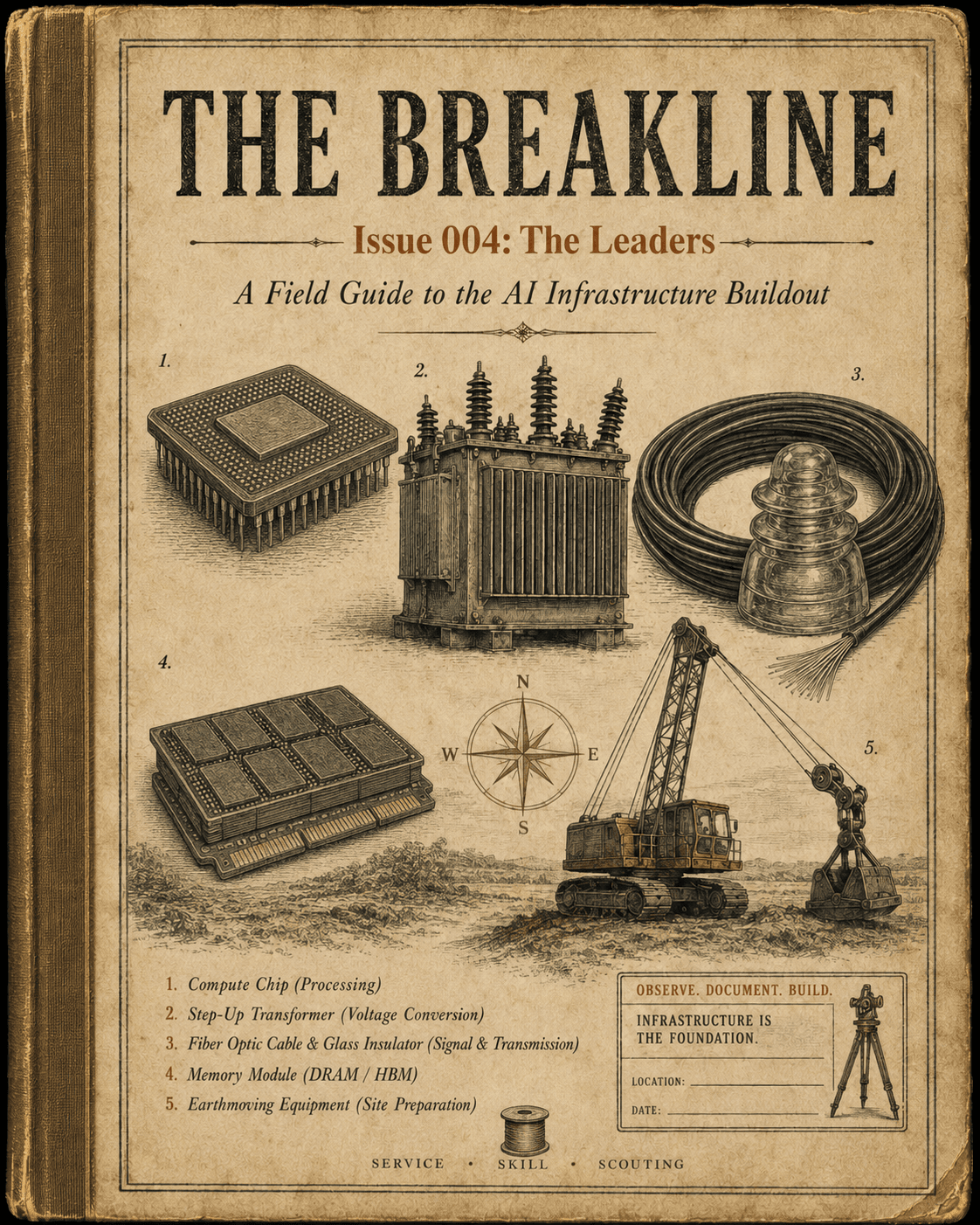
The Breakline — Issue 004: The Leaders
This issue is a field guide to the investable layers of the AI infrastructure buildout.
Each section begins with the market itself: where demand is accelerating, capacity is constrained, and capital spending is creating durable opportunities. The AlphaApes framework then identifies which public companies are leading, which are emerging, and where the signals disagree.
The result is not a static buy list. It is a map of the companies and indicators worth watching. Convergence across price, growth, technical strength, and risk quality suggests established leadership. Divergence shows where the market may be early, late, or wrong.
AlphaApes ranks roughly 3,600 public companies against one another. Relative Strength (RS) Master measures overall market leadership across price, growth, and ancillary signals. RS Risk provides a separate measure of risk quality. Upcomers show strong growth, improving price leadership, or both, but have not yet reached broad confirmation.
Compute: The Least Ambiguous Layer
The compute layer was the first part of the AI infrastructure trade to become obvious, and it remains the deepest pool of public-market leadership.
Demand is no longer the only accelerator. Every increase in model size and workload complexity expands the requirement for connectivity, memory, testing, packaging, and fabrication equipment. Semiconductor Equipment and Materials and Semiconductors are two of the three strongest industries in the AlphaApes universe by average RS Master, 84% and 82.5% respectively.
A trade dependent on one famous company is a story about one company. Leadership across designers, equipment manufacturers, testing companies, and component suppliers is an industry cycle.
ARM adds an important structural angle to the layer. It does not manufacture chips or sell finished accelerators. It licenses the instruction-set architecture and compute IP that other companies build on top of. That makes its leadership different from chip makers themselves. ARM is not just participating in compute demand. It sits closer to the underlying grammar of compute itself.
The AlphaApes readings match that position. ARM carries an RS Master of 99.5%, RS Risk of 97.4%, and RS Price of 99.75%, essentially as clean as AMD while representing a different kind of compute-layer exposure.
AMD shows similarly broad confirmation, ranking among the strongest companies in the universe with every major component above 94 percent. Teradyne and Lam Research show that leadership extends beyond chip designers and into the businesses required to manufacture and test them. Both rank among the strongest companies in the universe, with broad agreement across their major signals.
NVDA presents a different picture. Its RS Master remains above 92 percent, supported by exceptional growth and risk quality, but its price score sits closer to the middle of the universe. The business has not lost its strategic position. The stock simply is not showing the same current price leadership as the strongest names around it.
Broadcom carries a milder version of the same divergence. Growth remains elite, while price and risk quality have not fully joined it. Both companies remain central to the buildout, but their next investable signal is renewed convergence.
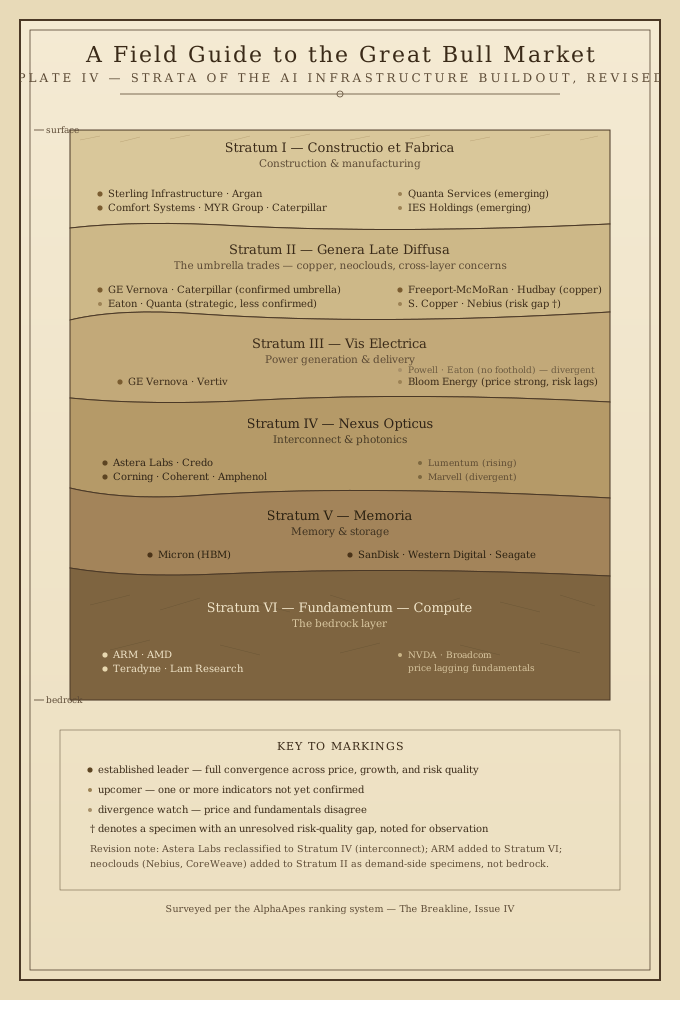
Established leaders: ARM, AMD, Teradyne, and Lam Research.
Reconfirmation candidates: NVDA and Broadcom. Watch whether price strengthens while growth and risk quality remain intact.
Memory: Scarcity Is Already in the Order Book
The memory layer has something most emerging markets do not: visible scarcity.
High-bandwidth memory capacity across the major suppliers is effectively committed through the end of the year. That demand is reflected in supplier order books. Estimates place the category’s total addressable market somewhere between roughly $35 billion and $100 billion by 2028, a wide range that still points in one direction: up.
Memory producers are reallocating capacity toward the products carrying the strongest demand and highest margins. The question has never been about whether AI requires more memory. It’s how quickly can supply expand without damaging the economics that made the shortage valuable?
Micron is the clearest public-market expression of the HBM trade inside the AlphaApes universe. It ranks third overall, with RS Master, Price, Growth, Ancillary, and Risk all above 98 percent. There is no meaningful disagreement between the major components.
SanDisk ranks first across the full universe with equally strong convergence, but its NAND flash represents a broader storage thesis rather than direct HBM exposure. Western Digital and Seagate provide additional confirmation, with exceptional price leadership and strong composite scores, although their risk-quality readings remain slightly below the preferred 80% level.
The divergence in this layer is volume. Micron and SanDisk both show weaker VolumeLine readings than their other major scores. Improving volume strength would add confirmation. Continued deterioration would suggest that exceptional price leadership is being carried by a narrower base.
Established leader: Micron.
Broader storage leaders: SanDisk, Western Digital, and Seagate.
Indicator to watch: Volume strength should begin moving toward the already-elite price and growth readings.
Interconnect: The Market Is Sorting the Winners
Compute receives the headlines, but interconnect determines whether the machines can communicate quickly enough to justify them.
The movement of data between processors is becoming one of the defining constraints of AI architecture. Copper remains useful over short distances, but power consumption and signal degradation increase as systems become larger and more densely connected. Optical interconnects move the constraint outward.
Estimates for the current co-packaged optics market vary by more than a hundred-fold–a signature that the category that has not yet agreed on its own boundaries. The applications are still fully unclear on where optics play the most important part and the market can’t yet decide on where to specifically apply capital. More broadly, the optical interconnect market is better understood, with estimates clustering around $16 billion to $22 billion today and reaching roughly $34 billion to $40 billion by the early 2030s.
AlphaApes shows that investors are not treating every optical and connectivity company as interchangeable.
Astera Labs belongs here rather than in the compute section. It sits in the semiconductor industry classification, but its real exposure is connectivity: the silicon infrastructure that helps AI systems move data between accelerators, memory, CPUs, and servers. That makes it one of the cleanest public-market expressions of the interconnect problem.
Its scores are exceptional. Astera ranks second across the entire AlphaApes universe, with its major price, growth, ancillary, and risk-quality readings all above 97 percent. That is not merely strong semiconductor leadership. It is direct confirmation that the market is rewarding the connective tissue of AI infrastructure.
Credo provides the second cleanest signal, ranking fourth across the universe with price, growth, ancillary, and risk-quality scores above 97 percent. Its weaker volume reading and compressed volatility suggest that the next acceleration is not yet fully reflected in the secondary indicators.
Corning, Coherent, and Amphenol provide broader confirmation. Each combines strong price leadership with high growth and risk-quality readings. Coherent is especially notable because its major scores agree without depending on one extreme price or growth component to carry the composite.
Lumentum is the emerging name. Its growth score sits above 93 percent and risk quality above 83 percent, while price remains near the lower third of the universe. The business indicators are present, but the market has not yet confirmed them through price leadership.
Marvell shows the opposite divergence. Its price and risk-quality scores are exceptional, but its growth reading remains materially lower. Lumentum needs price to catch its fundamentals. Marvell needs fundamentals to catch its price.
Established leaders: Astera Labs, Credo, Corning, Coherent, and Amphenol.
Upcomer: Lumentum.
Divergence watch: Marvell. Future snapshots should show whether growth rises to support its leadership or price begins to weaken.
Power: Demand Is Certain, Delivery Is Not
The power layer is where the AI infrastructure thesis becomes least tidy.
Forecasts for data-center electricity consumption vary too widely to support a single precise outcome, but they agree on direction. Data centers will require substantially more power, and the existing system is not prepared to deliver it easily.
The market is therefore separating electricity demand from electricity delivery.
Utilities rank near the bottom of the AlphaApes sector table. Their opportunity may be real, but it remains constrained by regulation, permitting, capital requirements, and long development timelines. The stronger trade is in the equipment and systems required to get power where it's needed.
Transformers and switchgear illustrate the problem. Equipment representing less than 10 percent of total data-center cost has become one of the most consequential bottlenecks in the project schedule. Lead times that ran roughly two years before 2020 can now extend toward five years. A relatively inexpensive component can delay an extraordinarily expensive facility.
Eaton’s acquisition of Boyd Thermal captures the market’s response. Electrical distribution and thermal management are increasingly part of the same system because a data center cannot add power without also removing the heat it creates. However, the stock has not performed well and can’t get a foothold trend.
GE Vernova is the strongest confirmed leader in this layer. Its RS Master is above 98 percent, with strong agreement across price, growth, ancillary, and risk quality. Vertiv follows closely, combining elite growth and ancillary scores with improving price confirmation.
Bloom Energy offers a more aggressive expression. Its on-site fuel cells allow customers to reduce dependence on the existing grid and, in some cases, bypass the transformer queue. The stock carries exceptional price and Master scores, but its risk-quality reading remains below 65 percent with real drag on debt to equity ratios and struggle with trend stability.
Powell Industries shows another divergence. Its price and ancillary readings are strong, while its growth score remains close to the middle of the universe. Eaton is also strategically compelling, but its growth and risk-quality readings remain below those of the strongest leaders.
Established leaders: GE Vernova and Vertiv.
Leader awaiting confirmation: Bloom Energy.
Divergence watch: Powell needs growth to catch price leadership. Eaton needs broader improvement across growth and risk quality.
Construction and Manufacturing: The Physical Economy Collects Its Share
Every data center eventually stops being a forecast and becomes a construction site.
US data-center construction spending now exceeds $28 billion annually, and that captures only part of the physical buildout. It does not fully reflect the generators, switchgear, cooling systems, cables, heavy equipment, and thousands of smaller components required before a facility can open.
Capital can approve a data center faster than industry can build one. Concrete remains stubbornly unimpressed by software margins.
Sterling Infrastructure ranks twelfth across the full universe, with exceptional agreement between price, growth, ancillary, and risk quality. Argan ranks seventeenth with similarly broad confirmation. Comfort Systems and MYR Group also show strong alignment across the major components, placing them among the most complete leadership profiles anywhere in the infrastructure map.
Caterpillar supplies the manufacturing counterpart. It carries an RS Master above 97 percent, with strong price, ancillary, and risk-quality readings. Growth is less exceptional, but not weak enough to contradict the broader signal.
Quanta Services is the more interesting upcomer. Growth sits above 87 percent, while price and risk quality remain materially lower. If future snapshots show those readings moving toward growth, Quanta would become one of the more consequential emerging leaders in the physical stack.
IES Holdings is closer to confirmation. Price, growth, ancillary, and Master scores are already strong, while risk quality sits immediately below the preferred threshold of 80%.
Established leaders: Sterling Infrastructure, Argan, Comfort Systems, MYR Group, and Caterpillar.
Upcomers: IES Holdings and Quanta Services.
Indicator to watch: The warning would be simultaneous deterioration across growth and price, particularly if backlogs remain strong while market leadership fades.
The Umbrella Trades: Owning the Buildout Without Picking One Bottleneck
Some companies span several layers at once. GE Vernova touches power generation, grid equipment, and service. Caterpillar participates in generation, construction, and heavy equipment. Eaton crosses electrical distribution and thermal management. Quanta sits across transmission, engineering, and construction.
Rather than betting on the precise component that becomes scarce, the investor owns a business positioned to collect spending across several possible constraints.
GE Vernova and Caterpillar currently combine broad exposure with strong AlphaApes readings. Eaton and Quanta possess equally compelling strategic positions, but their signals remain less complete.
The neoclouds deserve a separate callout, but not a forced placement inside Compute. Their business is different. They do not manufacture, license, or supply the physical buildout. They consume the output of the buildout by renting access to GPUs and AI compute capacity. That makes them demand-side infrastructure operators rather than component suppliers.
Nebius is the stronger current signal. Its RS Master sits at 97.7%, and it ranks first in its own industry, but RS Risk lags at 76.1%, below the preferred confirmation gate. That keeps it on the edge of leadership rather than fully inside it.
CoreWeave is much less confirmed. Its RS Master of 86.4% looks passable on the surface, but RS Risk sits at 46.2% and RS Growth at 48.5%. That is not a minor gap. It is a real divergence: price leadership running well ahead of both growth confirmation and risk quality. If anything, CoreWeave belongs closer to a future bear-case or dissent piece than the leader list in this one.
Copper is the material umbrella beneath all of them. The metal is required across power generation, transmission, transformers, cooling systems, construction, and the data centers themselves. Copper’s average RS Master rivals the semiconductor layer, although the industry contains only six companies and should not be treated as a broad sample.
Freeport-McMoRan and Hudbay Minerals provide the cleanest combination of leadership and risk-quality confirmation. Both carry strong Price and Growth readings, although their ancillary scores remain weaker than the rest of their profiles.
Southern Copper leads the group on RS Master, but its risk-quality score sits near 41 percent. Its market leadership is strong. The second layer of confirmation is not. Improving risk quality would strengthen the case; deteriorating price or growth would reveal a less balanced setup.
Confirmed umbrellas: GE Vernova and Caterpillar.
Strategic upcomers: Eaton and Quanta Services.
Neocloud watch: Nebius is strong but not fully risk-confirmed. CoreWeave is a divergence, not a leader.
Copper leaders: Freeport-McMoRan and Hudbay Minerals. Southern Copper remains the strongest momentum signal with the largest unresolved risk-quality gap.
What to Watch From Here
Each company leaves the reader with a specific condition to monitor.
The established leaders must maintain convergence. ARM, AMD, Micron, Astera Labs, Credo, Coherent, GE Vernova, Sterling Infrastructure, Argan, Comfort Systems, and MYR Group already have broad confirmation. Their next important signal is deterioration. When every major component is strong, weakening price, growth, or risk quality matters more than another incremental gain.
The upcomers require the opposite test. Lumentum, Quanta, IES, and Nebius need price or risk quality to rise toward their stronger business signals. NVDA and Broadcom need renewed price confirmation. Bloom Energy and Southern Copper need risk quality to strengthen. Marvell and Powell need growth to catch the leadership already reflected in their prices. CoreWeave needs both growth and risk quality to improve before it belongs in the leader conversation.
These changes should be followed across successive AlphaApes snapshots rather than inferred from one isolated reading. A single score describes the current position. The trend shows whether the investment case is becoming stronger or weaker.
Convergence turns an attractive story into confirmed market leadership. Divergence identifies the part of the story the market has accepted and the part it has not.
Compute has the deepest leadership bench. Memory has the clearest scarcity. Interconnect is still sorting its winners. Power favors the companies solving delivery constraints rather than the utilities inheriting demand. Construction is producing some of the strongest signals in the entire trade. The umbrella companies offer breadth, but only some have earned full confirmation.
Watch the layers. Watch the leaders. Most importantly, watch what changes.

Jason Bartlett
Jason Bartlett is CEO and President of Veche, Inc, parent company to Avalanche Markets. He works extensively in U.S. energy market finance and economics and is a member of the board of Thinking About Thinking, Inc--a 501c3 research and convening organization dedicated to advancing ideas about intelligence.